
menu
cancel
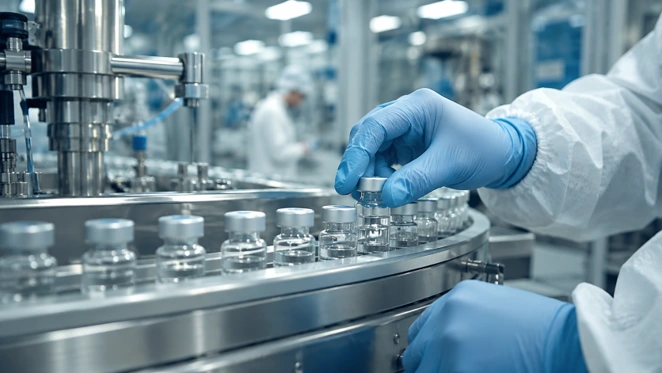
When people talk about peptides, the conversation often starts with the final product: the peptide name, a reported purity percentage, or the information available about it.
What is rarely discussed is everything that happens before that point.
Having worked across peptide development, manufacturing, testing, and distribution, I have seen that peptide manufacturing involves much more than chemistry. It requires controls, documentation, testing, and careful decisions throughout production.
Understanding the peptide manufacturing process helps explain what happens before a peptide batch is released.
The peptide manufacturing process includes the steps used to produce, purify, test, and document a peptide batch.
Peptides are chains of amino acids joined by peptide bonds. The order of those amino acids forms a specific sequence and determines which peptide is being produced.
Several manufacturing routes are available, including solid-phase, liquid-phase, and hybrid synthesis. The method used depends on factors such as the peptide’s length, complexity, required scale, and intended application. Solid-phase peptide synthesis remains one of the most widely used methods for producing synthetic peptides.
Most synthetic peptide manufacturing processes include six main stages:
1. Starting material preparation
2. Peptide synthesis
3. Cleavage and deprotection
4. Purification
5. Analytical testing
6. Batch review and release
Peptide manufacturing begins with the materials entering the process.
These can include protected amino acids, resins, solvents, coupling reagents, and other materials needed during synthesis. In solid-phase peptide synthesis, the resin acts as the support on which the peptide chain is assembled.
Incoming materials are evaluated against defined specifications before production begins. Depending on the material and quality system, manufacturers may examine identity, purity, supplier documentation, lot information, storage requirements, and other relevant characteristics.
Protected amino acids deserve particular attention. An incorrect amino acid, an unwanted isomer, or an impurity present in a starting material may carry forward into later stages of manufacturing. Resin characteristics also matter because loading and swelling properties can affect how efficiently the sequence is assembled.
The purpose of this review is not paperwork for its own sake. Manufacturers need to know what entered production, which lot was used, where it came from, and how it was handled.
This is where the history of the batch begins.
Once the starting materials have been approved, the amino acid sequence can be assembled.
Solid-phase peptide synthesis, or SPPS, builds the sequence one amino acid at a time while the growing chain remains attached to a solid support such as a resin. This makes it possible to wash away excess materials and byproducts between reaction cycles.
A typical cycle includes:
● Removing a temporary protecting group
● Activating and adding the next amino acid
● Allowing a new peptide bond to form
● Washing the resin before the next cycle
The process repeats until the planned sequence is complete.
Protecting groups are necessary because amino acids can contain several reactive sites. During synthesis, the manufacturer needs the reaction to occur in the correct place. Temporary protection helps prevent other parts of the molecule from reacting too early.
This stage becomes more difficult as sequences become longer or more complex. Each cycle introduces another opportunity for an incomplete reaction or unwanted side reaction.
For example, incomplete coupling can create a sequence that is missing an amino acid. Improper washing may contribute to an insertion, where an additional amino acid appears in the sequence. Certain reaction conditions can also increase the risk of racemization, which changes the spatial form of an amino acid.
Manufacturers may use in-process tests to check whether deprotection and coupling reactions have reached completion before continuing. Catching a problem during synthesis is preferable to discovering it only after the entire sequence has been assembled.
Once synthesis is complete, the peptide must be separated from the resin.
The remaining side-chain protecting groups must also be removed. This stage is known as cleavage and deprotection.
Strong reagents are commonly used to release the peptide and remove the protecting groups. The exact conditions depend on the sequence because some amino acids are more sensitive to oxidation or unwanted reactions than others. Manufacturers may use scavengers to reduce these reactions during cleavage.
The material produced at this stage is known as crude peptide.
It contains the intended peptide, but it may also contain:
● Truncated or incomplete sequences
● Deletion or insertion sequences
● Oxidized or otherwise modified variants
● Residual reagents and solvents
● Other process-related impurities
Crude peptide is therefore an intermediate, not the finished batch.
It must still be purified, isolated, and tested.
Purification separates the intended peptide from the other compounds present in the crude mixture.
Reversed-phase high-performance liquid chromatography is a common purification method. Other options may include ion-exchange chromatography, size-exclusion methods, membrane filtration, or crystallization, depending on the characteristics of the peptide and its impurities.
During chromatography, the crude material moves through a column. Different compounds travel through that system at different rates, allowing fractions to be collected separately.
Those fractions can then be analyzed. Fractions that meet the required criteria may be combined, while others may need additional purification or may be discarded.
Purification can be one of the most demanding parts of production. The target peptide may be chemically similar to the unwanted sequences created during synthesis, which can make separation difficult. Downstream purification can account for a substantial share of manufacturing work and operating cost.
After purification, the peptide must be isolated from the liquid process stream. Many peptides are freeze-dried through lyophilization, which removes water or solvent under controlled temperature and vacuum conditions. [3][5]
The result is commonly a dry peptide material that can proceed to final testing and review.
Purification does not confirm that the correct peptide was produced. That requires analytical testing.
Different tests answer different questions.
Analytical HPLC examines the sample’s purity profile and shows the presence of related compounds as separate peaks.
This can indicate how much of the detected material corresponds to the main peptide peak. However, an HPLC result alone does not fully confirm molecular identity.
Mass spectrometry measures molecular mass and helps determine whether the material matches the expected peptide.
When combined with liquid chromatography or additional sequence analysis, it can provide more detail about identity and impurities.
Depending on the peptide and manufacturing requirements, testing may also include:
● Sequence analysis
● Amino acid analysis
● Nuclear magnetic resonance
● Counterion testing
● Residual solvent testing
● Elemental impurity testing
● Moisture analysis
● Other peptide-specific characterization methods
Aurigene’s manufacturing materials, for example, describe the use of LC and high-resolution mass spectrometry, HPLC impurity profiling, NMR, sequence analysis, and testing for counterions and heavy metals.
No single test can describe every relevant characteristic of a peptide. A strong analytical program uses methods selected for the specific material and the questions that need to be answered.
Manufacturing does not end when the laboratory testing is complete.
Before release, the manufacturing records and analytical results must be reviewed together. [3][6]
This may include:
● Starting-material records
● Equipment and processing records
● In-process test results
● Deviations or unexpected events
● Purification records
● Final analytical results
● Packaging and storage information
● Release specifications
The purpose of batch review is to confirm that the approved process was followed and that the batch meets its established requirements.
Testing may show that a final sample meets a purity target, but the batch record explains how the material reached that result. It can also reveal whether anything unusual happened during synthesis, purification, or handling. [3][6]
This connection between process records and final testing is central to Chemistry, Manufacturing, and Controls, or CMC. Pharmaceutical quality documentation can include information about the manufacturing process, equipment, materials, in-process controls, specifications, analytical methods, packaging, and stability.
Release is the final decision that the available manufacturing and testing information supports approval of the batch.
Peptides can be affected by reaction conditions, temperature, pH, oxidation, incomplete coupling, residual materials, and improper storage or handling.
Poor control during synthesis may produce missing, added, or altered amino acid sequences. Problems during cleavage can leave protecting groups attached or create unwanted reactions. Weak purification may leave closely related impurities in the material. Inadequate storage can contribute to degradation or aggregation.
These changes may affect the identity, stability, consistency, or other characteristics of the peptide being studied.
That creates a scientific problem.
Researchers need to know that the material being evaluated matches what it is supposed to be. When the material varies between batches, contains poorly characterized impurities, or lacks supporting records, it becomes harder to interpret the results of the research built around it.
Manufacturing controls reduce that uncertainty.
They establish requirements for materials, define how production should be performed, identify risks during processing, and provide records that allow a batch to be investigated when something goes wrong.
Peptide manufacturing is a complex scientific process built around more than the final product.
From selecting starting materials to synthesizing, purifying, testing, and documenting a batch, every stage contributes to understanding what was produced and how it was evaluated.
As interest in peptides continues to grow, protecting the science behind them becomes increasingly important. Innovation should not be driven only by demand. It should be supported by research, testing, and manufacturing practices that allow the field to move forward responsibly.
If peptides are going to contribute to the future of science and human health, the foundation has to be built on more than hype. It has to be built on evidence, transparency, and a commitment to doing things properly.
1. Bachem. “Peptide Manufacturing: A Step-by-Step Guide.”
2. BioProcess International. “Understanding the Basics of Peptide and Protein Production.”
3. Pennington, Michael W., Brant Zell, and Chris J. Bai. “Commercial Manufacturing of cGMP Peptides Spanning the Gamut from Neoantigen to Commercial Large-Scale Products.”
4. Ludemann-Hombourger, Olivier, Per Möller, and François Kuster. “Downstream Processes for Peptide Manufacturing: Optimization Strategy and Latest Technical Trends.”
5. Aurigene Pharmaceutical Services. “Peptide Development and Manufacturing.”
6. Srivastava, Ved, ed. Peptide Therapeutics: Strategy and Tactics for Chemistry, Manufacturing and Controls. Royal Society of Chemistry.
7. Bachem. “Peptide Purification Process & Methods: An Overview.”
8. American Chemical Society. “Next-Generation Peptide Manufacturing: Green Chemistry and Sustainable Development.”
9. United States Pharmacopeia. “Peptide Manufacturing Workflow.”
This article is for general educational and informational purposes only. It does not constitute medical, legal, regulatory, scientific, or manufacturing advice.
The discussion of peptide manufacturing explains general processes and quality considerations. Requirements vary according to the peptide, manufacturing environment, intended application, governing regulations, and applicable quality standards.
Nothing in this article should be interpreted as a recommendation for personal peptide use or as a substitute for advice from qualified scientific, medical, legal, or regulatory professionals.