
menu
cancel
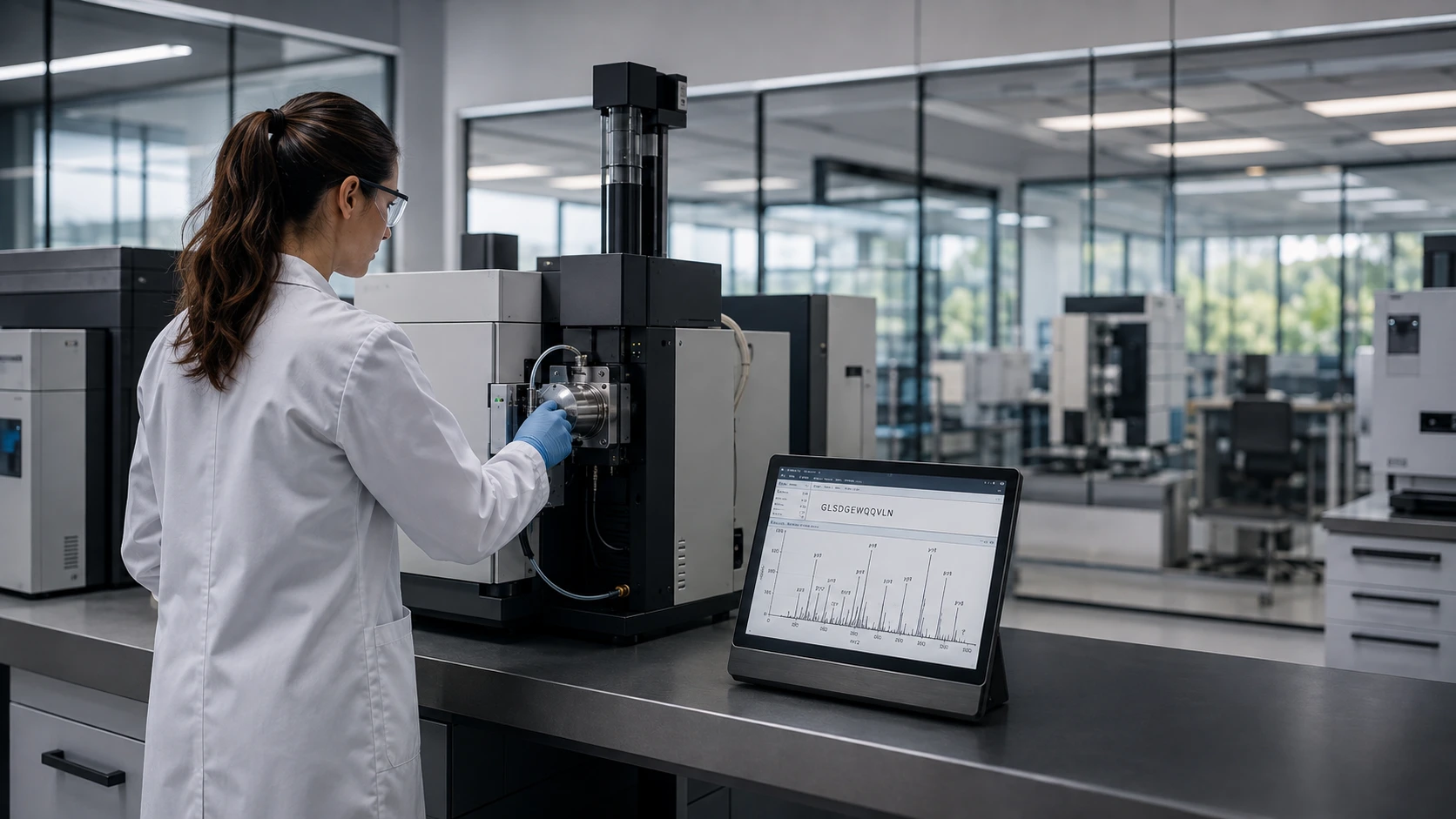
A peptide can look clean on a chromatogram and still be the wrong molecule.
That is the part most purity claims leave out.
Purity asks how much of the detected material belongs to the main peak. Identity asks whether that main material is actually the peptide named on the label. Those are different questions, and responsible testing has to answer both.
Having worked across peptide development, manufacturing, testing, and distribution, I have seen how easily a purity result gets treated like a complete answer. It is not. Before anyone can evaluate what a peptide may do, the laboratory first has to establish what the material is.
Peptide identity testing is the science of connecting a sample to the molecular structure it is supposed to contain.
Peptide identity testing uses analytical evidence to determine whether a sample contains the intended peptide. A meaningful identity test must be able to distinguish the target from structurally similar materials that could reasonably be present. [1]
For a synthetic peptide, that question can include more than confirming a product name. Laboratories may need evidence for molecular mass, amino acid sequence, composition, stereochemistry, counterions, chemical modifications, cyclization, disulfide bridges, or higher-order structure, depending on the molecule.
The required depth depends on complexity and intended use. A short linear peptide may be characterized differently from a long, cyclic, lipidated, pegylated, or disulfide-containing peptide.
This is why identity is not a single universal machine or one fixed test. It is a conclusion supported by methods selected for the molecule in front of the laboratory.
Peptide purity describes the profile detected by a selected method. Peptide identity establishes whether the main material matches the intended molecular structure. A high purity result cannot replace identity evidence.
A peptide is defined partly by the order of its amino acids. Change that order and the molecule can become a different peptide, even if the same amino acids are still present.
Manufacturing can also produce deletion sequences, insertion sequences, truncated material, epimers, oxidized forms, and other closely related structures. Some may differ from the target by one residue, one stereochemical orientation, or one chemical modification.
Those differences are not always visible to a basic purity test. Closely related peptides may elute near each other, co-elute as one peak, or produce signals that look convincing unless the method was designed to discriminate between them.
Identity testing therefore has to do more than find a large peak. It must connect the detected material to features that are specific to the intended molecule.
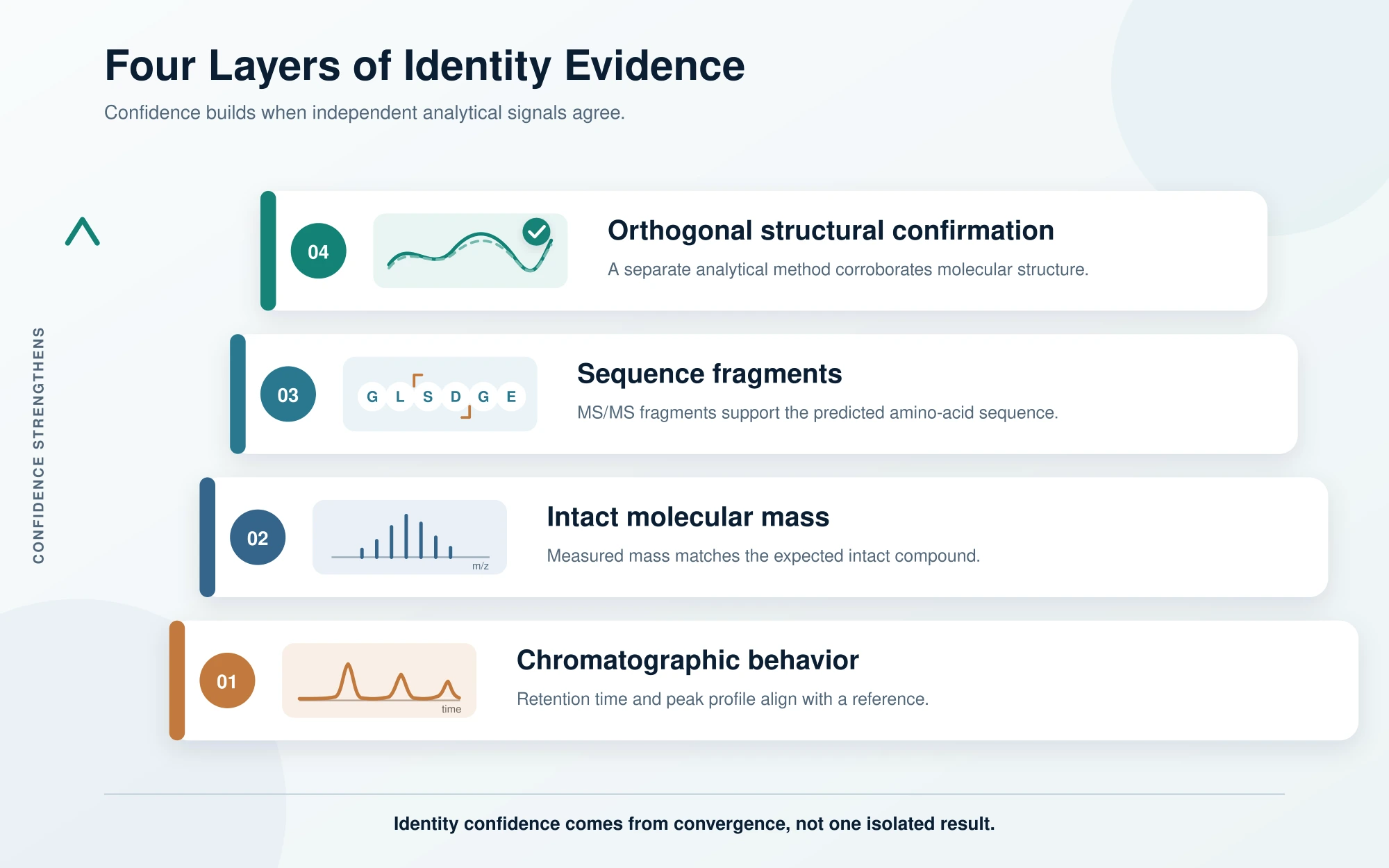
High-performance liquid chromatography, or HPLC, separates compounds according to their interactions with a column and mobile phase. When a test sample and a qualified reference standard show comparable retention behavior under the same method, that comparison can support identity.
HPLC is valuable because it can also reveal related substances and help show whether the main component is separated from impurities. But a single retention time is not considered specific enough to establish identity by itself.
Different compounds can sometimes produce similar retention behavior. A closely related impurity can also overlap with the target if the method lacks sufficient resolution. ICH Q6A specifically explains that identification solely by one chromatographic retention time is not regarded as specific.
That does not make HPLC weak. It means the result must be interpreted according to the question the method was designed to answer.
Chromatographic retention is strongest when the method has demonstrated specificity, the reference material is suitable, the system is performing as expected, and the target is adequately separated from likely interferences.
When those conditions are missing, a matching time on a chromatogram can create more confidence than the data deserve.
Mass spectrometry measures ions according to their mass-to-charge ratio. For peptide analysis, it can provide an observed molecular mass that laboratories compare with the mass calculated from the intended structure.
When the observed and theoretical values agree within an appropriate tolerance, the result supports the proposed identity. High-resolution instruments can provide greater mass accuracy and help separate signals that a lower-resolution method may not distinguish.
Liquid chromatography can also be coupled directly to mass spectrometry. LC-MS combines separation with mass information, allowing the laboratory to connect chromatographic peaks to molecular signals.
That combination is powerful, but the conclusion still has limits.
A correct intact mass does not automatically prove the full amino acid order, stereochemistry, folding, or position of every modification.
Different sequences can have the same amino acid composition and therefore the same total mass. Leucine and isoleucine also have the same elemental composition and mass, even though they are different amino acids. Some isomers and stereochemical changes may not be resolved by precursor mass alone.
Mass is an important identity layer. It becomes more convincing when sequence-specific or structurally independent evidence supports it.
Tandem mass spectrometry, commonly written as MS/MS, goes beyond measuring the intact peptide. The instrument isolates peptide ions and fragments them. The resulting pattern can be compared with the fragment masses expected from the proposed amino acid sequence.
In practical terms, the fragment pattern acts like a set of molecular checkpoints along the chain. When enough expected fragments are observed and correctly assigned, the laboratory can build stronger evidence that the sequence is correct.
The European Medicines Agency identifies LC-MS/MS of the intact molecule as one approach for amino acid sequence confirmation. For longer peptides, enzymatic digestion followed by peptide mapping may be more practical when complete intact-molecule sequencing is difficult.
The spectra still require interpretation. A report should connect observed fragments to theoretical values and explain the assignments rather than presenting an unlabeled image as proof.
Orthogonal methods approach the same identity question through different scientific principles.
One method might evaluate chromatographic behavior. Another measures molecular mass. A third examines sequence fragments or a structural property. Agreement across independent methods reduces the chance that one limitation or interference will produce a false conclusion.
ICH Q2(R2) recommends combining procedures when one method does not provide enough discrimination. The EMA's 2025 synthetic peptide guideline recommends at least two orthogonal methods for peptide identification as part of specification and release testing.
This does not mean every peptide needs every analytical technology. It means the test package should be strong enough to confirm the intended sequence without asking one method to prove what it cannot measure.
The appropriate supporting methods depend on the structure and the risk questions that remain.
Amino acid analysis can estimate which amino acids are present and their relative composition after the peptide is broken down. This can support the proposed formula, but composition alone does not preserve the original order of the sequence
Peptide mapping uses controlled cleavage to create smaller fragments that are separated and analyzed. The resulting map can act like a structural fingerprint and is especially useful for longer or more complex molecules.
Nuclear magnetic resonance, or NMR, can provide information about chemical environments, sequence features, structural motifs, and higher-order structure. A test spectrum may also be compared with a qualified reference spectrum under matching conditions.
Most amino acids are chiral. A peptide can contain the correct nominal sequence but the wrong stereochemical form at one position. Chiral chromatography, chiral GC-MS, enzymatic approaches, or other justified techniques may be needed when that risk is relevant.
A biological assay may add useful characterization when activity depends on structure that physicochemical methods cannot fully address. It is not automatically required for every synthetic peptide, and it should not replace direct chemical identity evidence when that evidence is available.
An identity result becomes more meaningful when the laboratory compares the sample with a well-characterized reference standard.
ICH Q6A describes a reference standard as material prepared for use in an assay, identification, or purity test, with quality appropriate to its purpose. Reference standards are often characterized using additional procedures beyond routine batch testing. [1]
The purpose matters. A standard suitable for system suitability or retention-time comparison may not carry every assigned value needed for quantitative assay. Its origin, qualification, storage, moisture control, requalification, and intended use all affect how the comparison should be interpreted. [3][5]
A sample does not become identified simply because the report mentions a standard. The method must show how the comparison supports the conclusion.
Development characterization and routine release testing serve related but different purposes.
During development, a manufacturer may use a broad group of techniques to establish detailed knowledge of the peptide's structure, impurities, physicochemical properties, and biological characteristics. Routine release specifications then use selected tests and acceptance criteria to confirm consistent quality for each batch.
A release identity test does not need to repeat every experiment performed during development. But it must remain specific enough for its intended purpose and connected to the broader characterization that justified its use.
This distinction matters when someone reads a certificate of analysis. The COA is a batch summary. It is not the entire scientific history of the molecule.
A useful identity section should make the evidence traceable. Depending on the document and test package, look for:
Not every public-facing COA will contain the full raw data package. But a responsible laboratory or manufacturer should be able to explain what supports the identity conclusion and how the report connects to the exact batch.
More information is needed when:
A red flag does not automatically prove that a product is wrong. It identifies a gap between the claim and the evidence shown.
Identity testing is not paperwork added after the real work. It protects the real work.
If the wrong sequence enters a study, every result becomes difficult to interpret. A weak outcome might be blamed on the biological target when the material was incorrect. A strong result might prove impossible to reproduce because another batch contains a different structure or impurity profile.
The same principle applies throughout the peptide manufacturing process. Starting materials, synthesis, purification, identity, purity, content, stability, and batch documentation all connect. A failure in one layer can distort what the next layer appears to show.
Confirming identity gives researchers, manufacturers, clinicians, and regulators a common starting point: we are discussing the same molecule.
Peptide identity cannot be reduced to a label, a large HPLC peak, or a number beside the word purity.
The right question is not, 'Does the report look scientific?' The right question is, 'Which molecular features were measured, which methods were used, and do those methods distinguish the target from realistic alternatives?'
HPLC can support the answer. Mass spectrometry can support the answer. MS/MS, peptide mapping, amino acid analysis, NMR, chiral methods, reference standards, and other tools can add the evidence a specific peptide requires.
The strongest conclusion comes from methods that agree for different scientific reasons.
That is what evidence first looks like in a laboratory. Confirm the molecule. Understand the method. Then decide what the result actually proves.
This article is for general educational and informational purposes only. It does not constitute medical, legal, regulatory, scientific, laboratory, or manufacturing advice.
The discussion of peptide identity testing explains general analytical concepts. Appropriate methods and requirements vary according to the peptide, test purpose, dosage form, manufacturing environment, intended application, governing regulations, and applicable quality standards.
Nothing in this article should be interpreted as a validation of any product, laboratory, manufacturer, or supplier, or as a substitute for advice from qualified scientific, medical, legal, regulatory, or laboratory professionals.