
menu
cancel
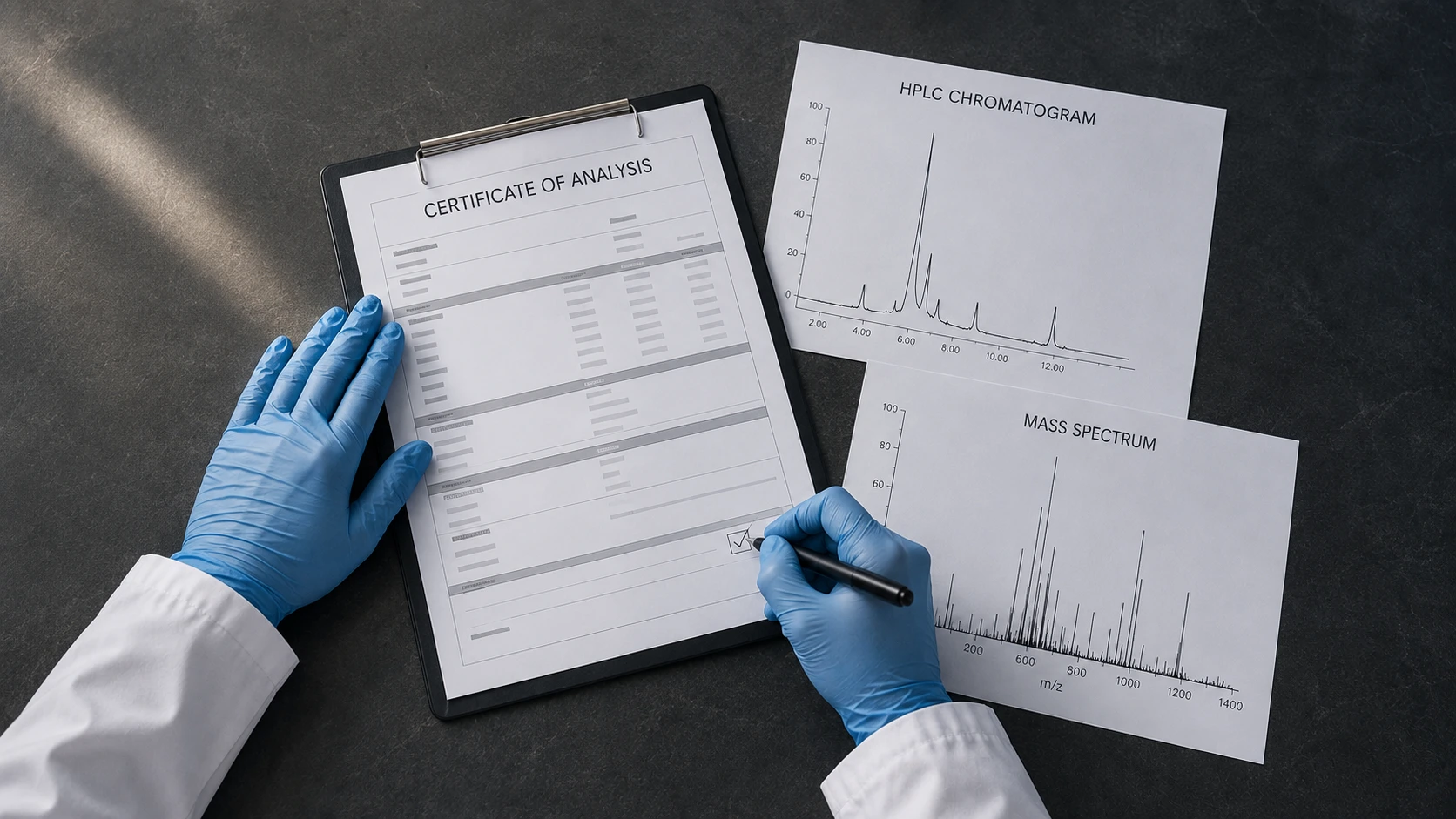
A certificate of analysis can look official and still leave the most important questions unanswered.
A logo, a purity percentage, and the word Pass are not enough.
The real value of a COA is not how scientific it looks. It is whether the document connects a specific batch to defined tests, suitable methods, clear acceptance criteria, actual results, and accountable review.
Having worked across peptide development, manufacturing, testing, and distribution, I have seen COAs treated like proof of everything at once. They are not. A COA is a summary of selected results for a specific sample or batch. Reading one well means understanding both what it shows and what it does not.
Here is how to evaluate a peptide certificate of analysis without getting distracted by the headline number.
A certificate of analysis, commonly called a COA, is a controlled document that reports tests performed on a particular sample, the results obtained, the acceptance criteria applied, and a conclusion about whether the sample conforms to the stated specification.
That definition matters because every part of it limits the claim. The certificate applies to the identified sample or batch. It reports the tests listed. It compares those results with a named specification. It does not automatically establish every quality attribute that someone might assume from the word certified.
A COA should help a reader answer five basic questions:
If the document cannot answer those questions, it may be a marketing attachment wearing a laboratory costume.
A COA is designed to communicate results. It is not normally the complete raw-data package behind those results.
For drug manufacturing under U.S. current good manufacturing practice, laboratory records include sample identification, methods, weights or measures, raw instrument outputs, calculations, results, dates, analyst identification, and independent review. The COA may summarize part of that evidence, while the full laboratory record holds the deeper traceability.
This is why a chromatogram or spectrum attached to a COA can be useful but is not automatically sufficient. The image has to be linked to the correct sample and lot, generated by a suitable method, interpreted against defined criteria, and retained with the underlying records.
The right mindset is simple: treat the COA as the front page of the evidence, not the entire book.
Before reading any test result, confirm that the certificate belongs to the material in front of you.
The product name, sequence or structural description, strength or grade when relevant, batch or lot number, sample identification number, manufacturer, testing laboratory, and applicable dates should agree across the COA, label, packaging, and supporting records.
The WHO model COA includes the batch number, sample registration number, dates received, manufacturer information, manufacture date when available, and expiry or retest date. It also calls for a unique certificate number and page numbering so every page can be recognized as part of the same document.
A strong result tied to the wrong lot is not evidence for the lot you have.
Look for the sample receipt date, testing date, report or approval date, manufacture date, and expiry or retest date when applicable. These dates should form a plausible sequence.
A retest date is not created by typing a future date onto a certificate. For regulated pharmaceutical materials, the retest period and storage conditions are supported by stability data and justified protocols. [6]
If a report is dated before the sample was received, if an approval date is missing, or if a retest period has no visible basis, ask for clarification.
Most useful COAs organize the core evidence into five columns: test, method, acceptance criterion, result, and compliance statement. Each column answers a different question.
The test names the quality attribute being evaluated, such as identity, purity, assay or content, water, residual solvents, counterion content, bacterial endotoxins, or microbiological quality. The appropriate test set depends on the peptide, material stage, intended use, manufacturing process, dosage form, and governing requirements.
The method explains how the laboratory generated the result. HPLC, LC-MS, MS/MS, Karl Fischer titration, gas chromatography, and microbiological procedures answer different questions.
A method name alone does not prove that the method is suitable. Analytical procedures need enough specificity, accuracy, precision, range, and other validated performance characteristics for their intended purpose.
The acceptance criterion is the predefined limit, range, or qualitative requirement the result must meet. It should exist before the result is interpreted.
Pass does not mean universally excellent. It means the reported result met the selected criterion under the stated method. The next question is whether that criterion is scientifically justified and appropriate for the material's intended use.
The result is what the laboratory actually observed. Numerical tests should normally show a value and unit when applicable, not only the word Pass.
A result of 99.1% area by one HPLC method, for example, is not interchangeable with 99.1% peptide content by mass. The number only has meaning when the test, method, calculation, and units are clear.
The compliance statement records whether the result met the stated criterion. It is the conclusion of the comparison, not a substitute for showing the comparison.
This is one of the most common COA mistakes.
Peptide purity usually describes the proportion of detected chromatographic area assigned to the main peak under a particular method. Peptide content or assay asks how much peptide is present on a defined mass basis. Water, counterions, residual solvents, and other nonpeptide material can affect the relationship between those numbers.
A sample can report high peptide purity while containing less peptide by total weight than the headline percentage suggests. That does not automatically mean the material fails. It means the reader has to identify which quantity was actually measured.
Read every percentage with its test name, method, units, and calculation basis attached.
A purity result cannot confirm that the main peak is the intended peptide.
Peptide identity testing may use mass, LC-MS, peptide mapping, amino acid analysis, NMR, chromatographic comparison, or other suitable methods. The EMA recommends at least two orthogonal identification methods for synthetic peptide active-substance specification and release, selected to confirm the sequence unambiguously.
On a COA, look for the method and observed conclusion. A theoretical molecular mass copied from a sequence calculator is not an observed identity result. An unlabeled spectrum is not a complete interpretation.
A COA only reports the tests it lists. Silence is not a passing result.
For synthetic peptide active substances, an appropriate specification may include appearance, identification, purity and individual impurities, assay or content, high-molecular-weight species when relevant, counterion identity and content, residual ions, water, residual solvents, elemental impurities, bacterial endotoxins, and microbiological purity. The list is explicitly nonexhaustive and must be tailored to the material and risk.
This does not mean every peptide COA should display every test in that list. Some information may sit in other quality documents, some tests may be periodic rather than batch-by-batch, and requirements differ by intended use and jurisdiction.
The responsible question is not, 'Why does this COA look shorter than another one?' It is, 'Which quality attributes matter for this material, which were tested for this batch, and where is the supporting evidence for the others?'
A certificate should identify the issuing laboratory and the authorized person who approved it. Contract or subcontracted testing should be identified when relevant, and the report should make clear which organization generated each result.
Laboratory accreditation can add information about the quality system and scope, but a logo or accreditation number should not be treated as proof that every listed analysis falls within that scope. Verify the laboratory, the report identifier, and the applicable scope directly when the decision warrants it.
Digital signatures and electronic reports can be legitimate. What matters is whether the report can be authenticated, traced to the issuing organization, and protected from undocumented changes.
The phrase third-party tested sounds reassuring because it suggests independence. Independence alone does not prove that the sample was representative, the method was suitable, the laboratory was competent for that test, or the report belongs to the batch being sold.
In the U.S. CGMP context for drug-product components, a manufacturer may rely on a supplier's report of analysis for certain attributes only while conducting at least one specific identity test and establishing the reliability of the supplier's analyses at appropriate intervals.
The broader lesson is useful even outside that exact regulation: a certificate should sit inside a supplier-qualification and quality system. It should not replace one.
Pause and ask for more information when you see:
A red flag is not automatic proof of fraud or failure. It is a reason to stop treating the certificate as self-explanatory.
Before relying on a peptide COA, ask:
If the answers are unclear, ask for the specification, method summary, raw-data package, laboratory contact, stability support, or supplier-qualification evidence appropriate to the decision. The higher the consequence of being wrong, the deeper the verification should go.
A COA is not paperwork sitting outside the peptide manufacturing process. It is one of the tools used to connect a batch to the decisions that produced and released it.
When the certificate is specific, traceable, and supported, it helps researchers, manufacturers, clinicians, quality teams, and regulators speak about the same material. When it is vague, every conclusion built on that batch becomes harder to trust.
The goal is not to distrust every document. It is to match confidence to evidence.
A peptide certificate of analysis should never be judged by polish alone.
Start with the batch. Identify the laboratory. Read the test, method, acceptance criterion, result, and compliance statement as one connected line of evidence. Separate purity from identity and content. Notice what was not tested. Confirm who reviewed the work.
Most importantly, remember what the document is designed to be: a controlled summary for a defined sample, not universal proof of quality and not the complete laboratory record.
A good COA makes careful questions easier to answer. A weak one depends on the reader not asking them.
Evidence first. Batch by batch. Claim by claim.
2. Electronic Code of Federal Regulations. 21 CFR 211.194: Laboratory Records.
This article is for general educational and informational purposes only. It does not constitute medical, legal, regulatory, scientific, laboratory, quality-system, supplier-qualification, or manufacturing advice.
The appropriate contents of a certificate of analysis, test methods, specifications, acceptance criteria, and supporting records vary according to the peptide, material stage, intended use, dosage form, manufacturing environment, jurisdiction, and applicable quality standards.
The fictional COA example uses invented names, codes, limits, and results solely to explain document structure. Nothing in this article should be used to release a product, determine clinical suitability, validate a supplier or laboratory, or replace review by qualified scientific, medical, legal, regulatory, laboratory, or quality professionals.