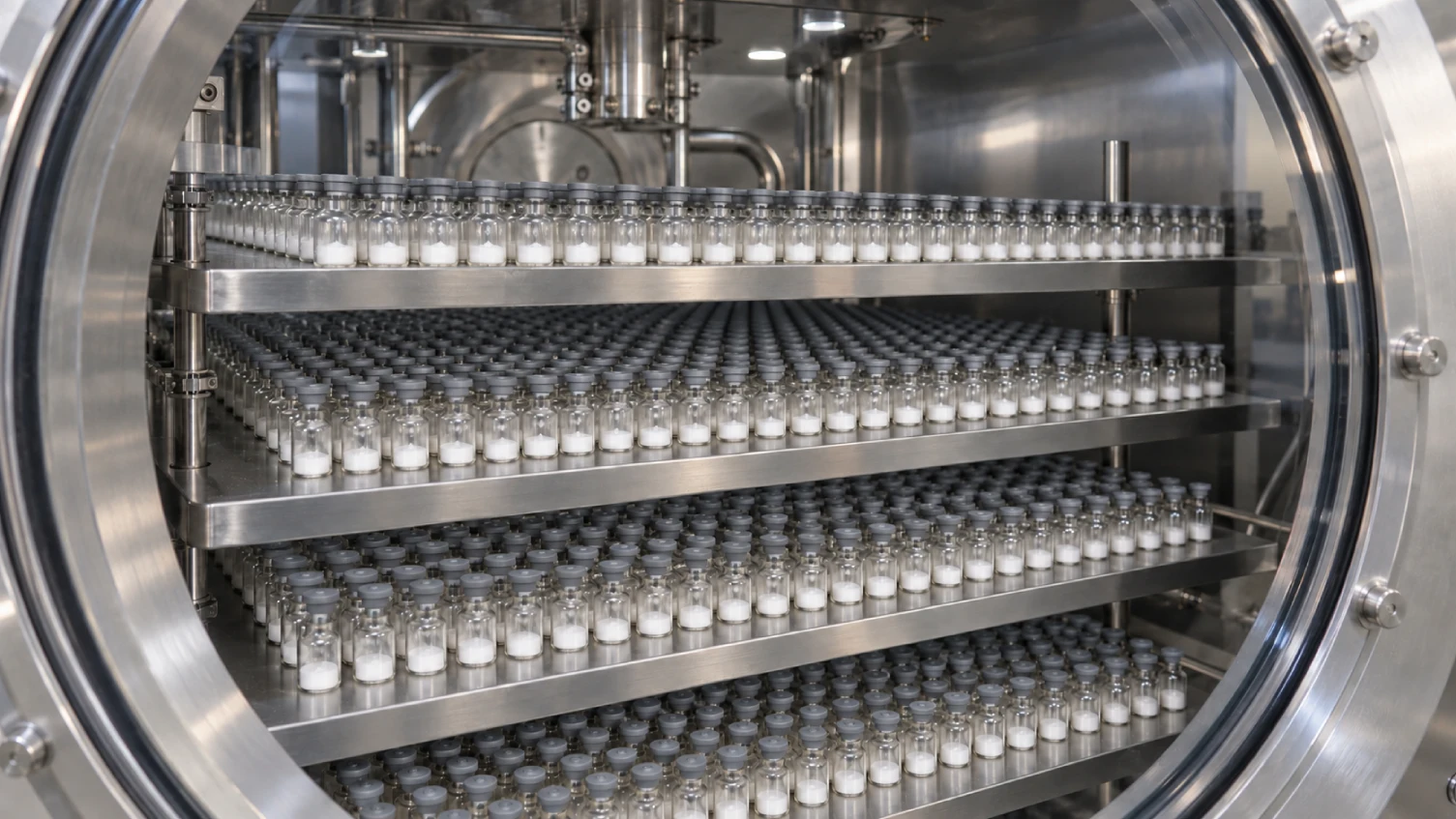
A white cake at the bottom of a vial can look reassuring. It can also tell you far less than you think.
Freeze-drying can help protect a well-made peptide. It cannot purify it, confirm its identity, sterilize it, or rescue a batch that was poorly synthesized or inadequately tested.
That distinction matters because the word lyophilized is often treated like a quality grade. It is not. Lyophilization is a manufacturing process, and the value of that process depends on the formulation, the cycle, the equipment, the container, the controls, and the evidence generated around the batch.
Having worked across peptide development, manufacturing, testing, and distribution, I have seen the final appearance receive more attention than the decisions that created it. The science works in the opposite direction. A strong lyophilized product begins with a strong process.
Here is what freeze-drying actually does, why manufacturers use it, and what a finished cake can and cannot prove.
What Does Lyophilized Mean?
Lyophilized means freeze-dried.
In pharmaceutical lyophilization, a liquid formulation is frozen and placed under vacuum so that ice can move directly from a solid to a vapor without first becoming liquid. The overall process has three interdependent stages: freezing, primary drying, and secondary drying.
That direct solid-to-vapor change is called sublimation. It allows much of the water to be removed at controlled temperatures that may be more suitable for heat-sensitive materials than conventional drying.
The result is often a porous solid known as a cake. The word cake describes the physical structure left in the vial. It is not a statement about peptide purity, peptide content, sterility, or intended use.
Why Are Some Peptides Freeze-Dried?
Water is necessary for many laboratory and pharmaceutical processes, but it can also create conditions in which a peptide changes over time. Depending on the sequence, formulation, pH, temperature, oxygen, light, and other factors, degradation pathways may include hydrolysis, oxidation, aggregation, deamidation, or other chemical and physical changes.
Removing most of the water can reduce molecular mobility and slow certain degradation pathways. FDA guidance identifies enhanced stability in the dry state and water removal without excessive heating among the advantages of lyophilization.
The careful word is can. A peptide does not become indefinitely stable because it was freeze-dried. Stability still has to be demonstrated for the actual formulation in its actual container under defined storage conditions.
Lyophilization is therefore not a universal finishing step. It is one possible solution to a specific formulation and stability problem.
Within the broader peptide manufacturing process, freeze-drying usually happens after synthesis and purification have produced a controlled liquid process stream. It preserves the material that reaches the dryer. It does not rewrite the history of the batch.
01
Freezing
Liquid water becomes ice
The formulation is cooled until the water phase freezes and the
dissolved components become concentrated in the remaining unfrozen
phase.
Process focus:
Freezing rate, nucleation, product temperature, and solid-state
behavior
02
Primary Drying
Ice leaves by sublimation
Vacuum is applied and controlled shelf heat supplies energy so frozen
water can move directly from ice to vapor.
Process focus:
Shelf temperature, product temperature, chamber pressure,
condenser performance, and endpoint
03
Secondary Drying
Bound water is reduced
After visible ice is gone, temperature is adjusted so more tightly
associated water can leave by desorption.
Process focus:
Product-specific residual moisture target, time, temperature, and
container closure
Stage 1: Freezing Builds the Structure
The first stage does more than make the vial cold.
As ice crystals form, the peptide, buffer components, salts, and excipients become concentrated in the portion that has not yet frozen. The rate and manner of freezing can influence ice-crystal size, the spaces left behind after sublimation, concentration gradients, and the physical form of components in the formulation.
Larger ice crystals can leave larger pores, which may reduce resistance to water-vapor flow during primary drying. But changing the freezing conditions can also change how components separate, crystallize, or concentrate. Faster is not automatically better, and slower is not automatically better.
This is one reason a cycle cannot simply be copied from one peptide to another. Sequence, concentration, excipients, fill volume, vial geometry, and batch scale can all change how the formulation freezes and dries.
Stage 2: Primary Drying Removes Ice
Once the formulation is frozen, the chamber pressure is reduced. Controlled heat is supplied through the shelves, giving the ice enough energy to sublime.
Primary drying is often the longest part of the cycle. The manufacturer has to provide enough heat to drive sublimation without allowing the product to become warmer than the formulation can tolerate. If the product temperature rises too far, the structure may collapse or undergo other undesirable changes.
The process is a balance of heat transfer and mass transfer. Heat has to reach the product. Water vapor has to leave the vial, move through the dried layer, enter the chamber, and be captured by the condenser.
That balance is why shelf temperature alone is not the complete story. Product temperature, chamber pressure, condenser temperature, equipment capability, load configuration, and drying time all help define what the batch actually experienced.
Stage 3: Secondary Drying Reduces Bound Water
When primary drying ends, the visible ice may be gone, but the product is not necessarily at its final moisture level.
Some water remains associated with the dried matrix. During secondary drying, the product temperature is generally adjusted under vacuum so additional water can leave by desorption.
The objective is not to chase an abstract value of zero. It is to reach a residual-moisture range that is justified for that formulation and linked to acceptable quality throughout storage.
That target is product-specific. A moisture result only becomes meaningful when it is connected to a validated method, a defined specification, representative sampling, and stability data.
Residual Moisture Is a Quality Attribute, Not a Guess
A lyophilized product is dry, but dry does not mean water-free.
Residual moisture can affect chemical stability, physical stability, glass-transition behavior, and the condition of the cake during storage. FDA inspection guidance states that manufacturers should establish moisture specifications for release and stability with data showing adequate stability at that limit. [1]
For synthetic peptide active substances, the EMA guideline identifies water content among the attributes that may need to be included in an appropriate specification. It also notes that water content may need to be monitored in stability studies for hygroscopic powders. [5]
This is why a statement such as lyophilized to less than 1% moisture is not automatically impressive. The scientifically useful questions are:
How was residual moisture measured?
Was the method suitable for this formulation?
Where in the load were samples taken?
What release limit was defined?
What stability data support that limit?
A low number without that context is another isolated claim. Evidence requires the connection.
The Formulation Is Part of the Process
A lyophilized vial may contain more than the peptide and residual water.
Depending on the product, the formulation may include a buffer, bulking agent, stabilizer, surfactant, cryoprotectant, lyoprotectant, or other excipients selected for a defined function. These components can influence pH, freezing behavior, cake structure, protein or peptide interactions, reconstitution performance, and storage stability.
Calling every excipient filler misses the science. An excipient may create physical structure, protect the molecule during freezing and drying, or help the product behave consistently after the cycle.
The reverse is also true: adding an excipient does not guarantee protection. Type, amount, grade, compatibility, and the way the component behaves during the cycle all have to be understood.
Why Process Control Matters More Than the Word Lyophilized
A successful cycle is not defined only by the fact that the chamber reached vacuum and the vials came out dry.
Pharmaceutical development connects material attributes and process parameters to critical quality attributes. For lyophilization, that can include relationships among formulation composition, freezing conditions, shelf temperature, product temperature, pressure, drying time, residual moisture, cake structure, potency, purity, and stability.
ICH Q8 even uses the temperature-and-pressure cycle of lyophilization as an example of a time-dependent design space. That is a useful reminder: the cycle is a controlled path, not a single setting.
The process also has to work across the actual manufacturing load. Vials near a chamber wall may not experience exactly the same heat-transfer conditions as vials in the center. Different vial sizes, fill volumes, batch sizes, and equipment scales can require different cycle parameters and separate evidence.
A manufacturer therefore needs more than an endpoint test. The batch record should show what happened throughout the cycle and whether critical parameters remained within the validated ranges.
Does a Beautiful Freeze-Dried Cake Prove Quality?
No.
Cake appearance matters because visible changes can reveal useful information. Collapse, meltback, excessive shrinkage, cracking, discoloration, or inconsistency across the batch may trigger investigation. FDA guidance describes meltback as a form of collapse associated with incomplete sublimation, a possible moisture pocket, physical change, and increased risk of instability.
But the opposite conclusion does not follow. A uniform white cake is not proof that the peptide is correct, pure, potent, sterile, stable, or present in the stated amount.
Scientific literature on lyophilized cake appearance makes the nuance clear: appearance can be important, but a nonideal cake does not always affect product quality. The significance of a visual attribute has to be established using product knowledge, critical quality attributes, and a science-based risk assessment.
Appearance is a signal. It is not a substitute for analytical data.
What Lyophilization Cannot Prove
The presence of a freeze-dried cake cannot establish:
Identity: whether the material is the intended peptide
Purity: how much of the detected profile corresponds to the main peptide
Content or assay: how much peptide is present on a defined basis
Sterility: whether viable microorganisms are absent under the applicable test and process controls
Endotoxin control: whether bacterial endotoxin is within an appropriate limit
Uniformity: whether each vial contains the intended amount
Stability: whether quality remains acceptable through the proposed storage period
Those are separate questions. They require separate evidence.
Freeze-Drying Is Not Sterilization
Freezing and vacuum drying are not substitutes for a validated sterilization strategy or aseptic processing. For sterile products, partially stoppered vials remain vulnerable during transfer and loading, which is why FDA guidance requires protection in critical areas and control of the lyophilizer, gas systems, transfer, loading, and stoppering operations. [1][4]
A sterile claim has to come from the complete manufacturing and testing system, not from the presence of a dry cake.
What Should the Quality Evidence Show?
When reviewing a lyophilized peptide, the certificate of analysis and supporting records should make it possible to distinguish the drying process from the quality of the material.
Depending on the material stage, intended use, dosage form, and applicable requirements, relevant evidence may include:
Batch identity and traceability
Peptide identity testing
Purity and impurity profile
Peptide content or assay on a stated basis
Residual moisture or water content with method and specification
Counterion, residual solvent, or other composition testing when relevant
Microbiological quality, sterility, and endotoxin controls when applicable
Cycle records, deviations, and evidence that the process stayed within validated parameters
Stability data supporting storage conditions, retest period, or shelf life
Not every document will display every item. The important point is that the evidence exists, applies to the correct batch, and supports the claim being made.
Five Myths About Lyophilized Peptides
Myth 1: Lyophilized Means Pure
Freeze-drying removes water. It does not selectively remove deletion sequences, oxidized variants, residual solvents, counterions, or other impurities. Purification and analytical testing are separate manufacturing stages.
Myth 2: A Bigger Cake Means More Peptide
Cake volume can be influenced by fill volume, solids concentration, excipients, vial dimensions, and freezing behavior. Visual size is not a quantitative peptide assay.
Myth 3: White and Uniform Means High Quality
Color and structure can be useful inspection attributes, but appearance cannot replace identity, purity, content, sterility, or stability testing.
Myth 4: Every Peptide Can Use the Same Cycle
Cycle design is formulation-specific and scale-sensitive. What protects one peptide, concentration, vial, or batch size may not be appropriate for another.
Myth 5: Lyophilized Means Stable at Any Temperature
Storage conditions and usable life are established through stability studies. A dry format can improve stability without eliminating sensitivity to heat, moisture, oxygen, light, or time.
Conclusion
Lyophilization is one of the most valuable tools available for stabilizing sensitive pharmaceutical materials. It is also one of the easiest words to overinterpret.
The process freezes a formulation, removes ice by sublimation, and reduces remaining water by desorption. Every stage depends on controlled temperature, pressure, time, equipment performance, formulation behavior, and batch-specific records.
A successful cycle may produce an elegant cake. But the cake is the visible outcome, not the complete evidence.
The better question is not, 'Does this peptide look freeze-dried?'
It is, 'Was this formulation and cycle designed, controlled, tested, and supported well enough to preserve the quality that was already there?'
That is where confidence begins: not with appearance, but with process understanding and proof.
Evidence first. Process by process. Batch by batch.
This article is for general educational and informational purposes only. It does not constitute medical, legal, regulatory, scientific, laboratory, quality-system, storage, handling, or manufacturing advice.
The value and requirements of lyophilization depend on the peptide, formulation, material stage, intended use, dosage form, manufacturing process, equipment, container-closure system, jurisdiction, and applicable quality standards. Storage conditions, retest periods, shelf life, specifications, and testing programs must be supported for the specific material and use.
Nothing in this article should be used to determine product suitability, release a batch, establish a lyophilization cycle, assign storage conditions, make a clinical decision, or replace review by qualified scientific, medical, legal, regulatory, laboratory, engineering, or quality professionals.