
menu
cancel
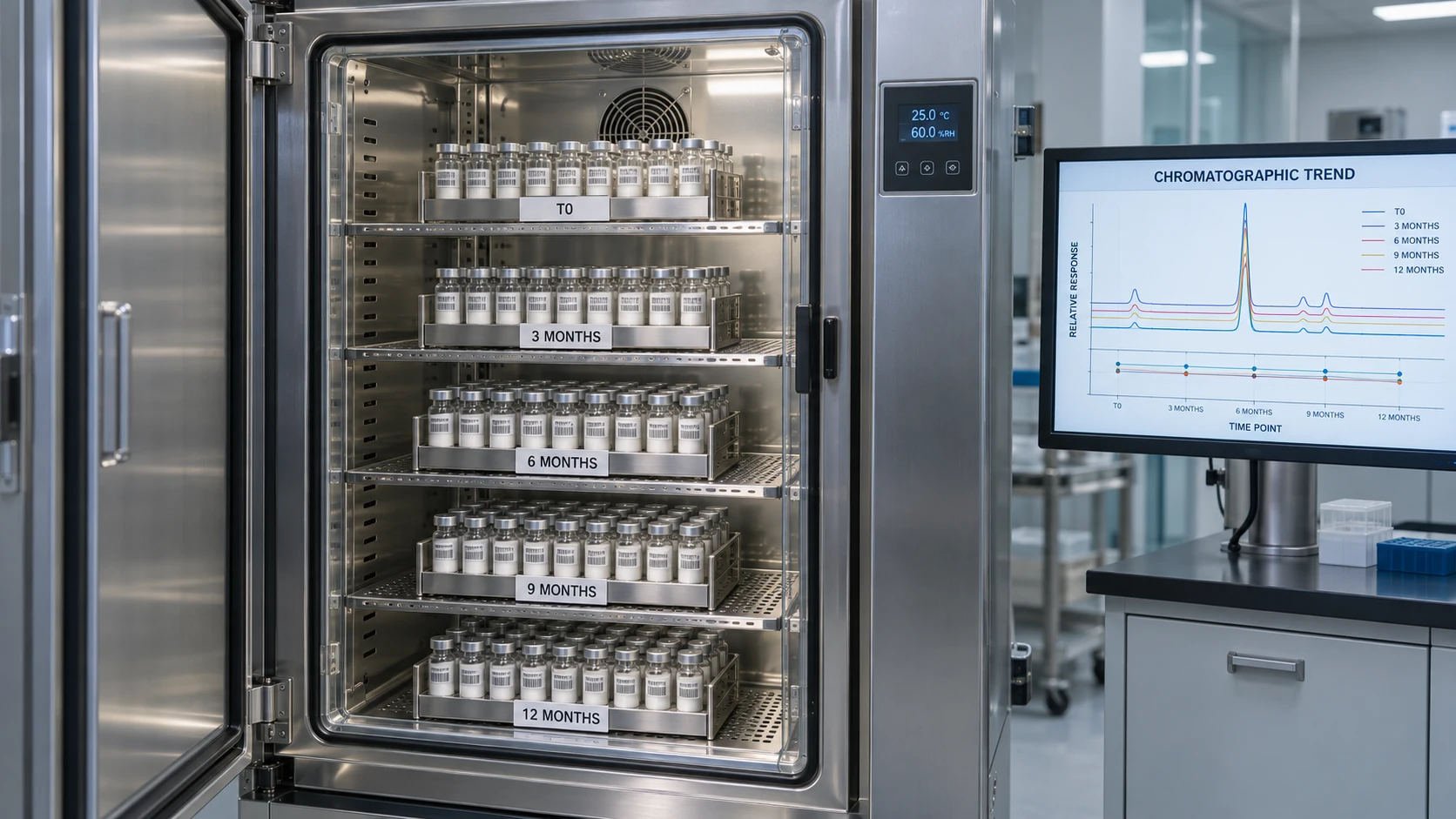
A peptide can pass every release test today and still change tomorrow.
That is not a contradiction. Release testing and stability testing answer different questions.
Release testing asks whether a batch meets its specifications at a particular moment. Stability testing asks whether the material continues to meet defined quality requirements as time passes under stated conditions.
The distinction matters because stability is often reduced to a storage phrase on a label. Keep refrigerated. Protect from light. Use before a date. Those statements should be the conclusions of a study, not substitutes for one.
Having worked across peptide development, manufacturing, testing, and distribution, I have seen stability treated as though it belongs to the sequence alone. It does not. Stability is shaped by the peptide, formulation, physical form, container, environment, test method, and time.
Here is what peptide stability actually means, what can change, and what credible evidence should show.
Peptide stability is the ability of a defined material or product to remain within justified quality limits for a stated period under stated conditions.
Those quality limits may address chemical, physical, biological, and microbiological attributes, depending on the material and its intended use. ICH guidance describes stability testing as the evidence used to understand how quality changes with time under environmental factors such as temperature, humidity, and light, and to establish storage conditions and a retest period or shelf life.
Every word in that definition matters:
A claim without those boundaries is not a stability conclusion. It is an assumption.
A certificate of analysis usually summarizes results from one testing event. That information may be important, but it does not show the direction or rate of change.
A stability program examines representative samples at defined intervals. The results are compared across time to determine whether assay, purity, degradation products, moisture, appearance, aggregation, potency, or other relevant attributes remain acceptable.
Heat, light, moisture, and time are useful categories, but they do not act in isolation. Heat may accelerate oxidation. Light may initiate chemical change. Moisture may enable hydrolysis or alter a dried matrix. Time allows those changes to accumulate.
The outcome depends on the sequence, formulation, packaging, and conditions. That is why generic storage claims cannot replace product-specific evidence.
Temperature influences the rate of many chemical reactions and the movement of molecules within a liquid or solid matrix. As temperature rises, susceptible degradation pathways may proceed faster. Physical changes such as aggregation, precipitation, collapse, or phase separation may also become more likely, depending on the formulation.
This is why formal stability programs include defined temperature conditions and why stress or accelerated studies may use elevated temperatures to reveal likely degradation pathways or compare formulations.
But an elevated-temperature result is not permission to invent a shelf life. Accelerated data can help evaluate short-term excursions and support projections in appropriate circumstances, but extrapolation has limits and has to be scientifically justified. Long-term data remain central to the conclusion.
Heat is therefore not a simple on-off switch. The useful question is how quickly relevant attributes change at defined temperatures in the actual formulation and container.
Light can drive photochemical reactions directly or contribute to oxidation through photosensitive components. A peptide may be affected by the wavelength and intensity of light, the duration of exposure, the formulation, dissolved oxygen, impurities, and the protection provided by the container and outer packaging.
ICH Q1B treats photostability as a formal part of stress testing. Its framework progresses from direct exposure of the substance or product to evaluation in the immediate and marketing packs when needed. The goal is to determine whether light causes unacceptable change and whether packaging or labeling precautions are necessary.
A proper photostability study also separates light effects from heat effects. ICH describes temperature control or a protected dark control so that a change caused by localized warming is not mistaken for photodegradation.
Dark glass may be part of a protection strategy. It is not proof that the contents are photostable.
Water matters in both liquid and solid systems.
In solution, water participates in hydrolysis and supports molecular mobility. In a dried or lyophilized material, residual moisture and moisture entering through handling or the container-closure system can alter the matrix and create conditions that change degradation rates.
Synthetic peptides may also be hygroscopic, meaning they can take up moisture from the surrounding environment. The EMA guideline calls for moisture-related precautions for hygroscopic peptide powders and expects water content to be included in stability protocols when relevant.
This does not mean the scientifically correct target is always zero water. The relevant question is whether water content is measured with a suitable method, controlled within a justified range, and connected to stability data for that specific material.
Time is not a degradation mechanism. It is the dimension that lets a stability program reveal one.
One result can show the state of a sample. Repeated results can show whether an impurity is increasing, assay is declining, moisture is shifting, aggregates are appearing, or variability is widening across batches.
ICH Q1A describes scheduled long-term and accelerated time points because stability has to be evaluated as a pattern, not a single endpoint. More frequent testing is expected when accelerated conditions are used and when rapid change could otherwise be missed.
The same principle applies to a claimed excursion. A temperature spike, light exposure, or moisture event cannot be interpreted from duration alone. The conditions, product, container, available stability data, and affected attributes all matter.
Peptides do not share one universal failure mode. The amino acid sequence creates different chemical liabilities, and the formulation and environment determine which pathways become relevant.
Oxidation changes susceptible amino acid side chains or other components through reactions involving oxygen or reactive species. Cysteine and methionine are well-known sequence considerations, although the practical risk depends on the entire system. Light, trace metals, peroxides, oxygen in the headspace, and formulation components may influence the pathway.
An oxidized variant may have a different mass, chromatographic behavior, charge, conformation, or biological activity. The analytical package has to be able to detect and, when necessary, characterize the change.
Hydrolysis is bond cleavage involving water. Depending on the sequence and conditions, hydrolytic change may affect the peptide backbone or other labile chemical groups. Temperature, pH, and the local sequence environment can alter the rate.
The presence of water does not prove that hydrolysis will be the dominant pathway. It means hydrolysis has to be considered and tested where the molecule and formulation make it plausible.
Deamidation can change asparagine or glutamine side chains, producing variants with different charge and, in some cases, altered structure or function. Asparagine deamidation may proceed through an intermediate that can also create an isomerized form. Sequence context, pH, temperature, and formulation all influence the risk.
These changes can be subtle. A method that measures only total peptide content may miss a redistribution among closely related variants.
Aggregation occurs when peptide molecules associate into larger species. The association may be reversible or irreversible, covalent or noncovalent, soluble or visible as particles. Concentration, interfaces, agitation, temperature, pH, ionic environment, and sequence characteristics may all contribute.
The EMA guideline specifically identifies aggregates, dimers, oligomers, and other high-molecular-weight impurities as issues that may arise during synthesis or storage and should be investigated with suitable techniques when applicable. [3]
A clear vial does not rule out soluble aggregates. Appearance is one observation, not a complete aggregation method.
Two materials can have the same nominal amino acid sequence and behave differently over time.
The surrounding system changes the risk. Relevant variables can include:
This is why a stability claim cannot be transferred casually from a published paper, a different supplier, a different concentration, or a different container. The evidence has to match the material being claimed.
A credible stability program begins with a written protocol and a clear question. It does not begin with a preferred expiration date.
Depending on the peptide, product stage, dosage form, intended use, and applicable standards, the program should address the following elements:
Formal studies should use batches that represent the intended manufacturing process and quality. ICH Q1A generally calls for data from at least three primary batches for a new drug substance or product, with specific expectations for batch scale and manufacturing route.
The container is part of the stability system. Light transmission, moisture vapor transmission, oxygen exposure, extractables, adsorption, closure integrity, and headspace can affect the result. Formal data should come from the same or a justified simulation of the proposed package.
Temperature, humidity, light exposure, orientation, duration, and sampling intervals should be specified in advance. The conditions need to address long-term storage and, where appropriate, accelerated, intermediate, stress, photostability, excursion, transport, freeze-thaw, or in-use questions.
A stability-indicating method is capable of detecting relevant change in the presence of the unchanged peptide. Forced degradation studies can help reveal likely pathways and demonstrate that methods can separate and detect the resulting products.
For complex peptide or biological products, one assay rarely tells the whole story. ICH Q5C describes a stability-indicating profile that can detect changes in identity, purity, and potency using a product-specific group of methods.
The test panel should be chosen around known and plausible risks. Depending on the material, that may include:
The correct panel is product-specific. A long list is not automatically a good program if the methods cannot detect the changes that matter.
Specifications, significant-change criteria, handling rules, statistical methods, and investigation pathways should be defined and justified. Results across batches should be evaluated together, including variability and trends, rather than reduced to isolated pass or fail marks.
U.S. current good manufacturing practice regulations likewise require a written stability testing program with sample sizes, test intervals, storage conditions, reliable methods, and testing in the marketed container-closure system.
Accelerated stability testing is valuable because it may reveal change sooner than long-term storage. It can help identify degradation pathways, compare formulations, evaluate the effect of short excursions, and support a limited projection when the data and model justify it.
It cannot automatically compress years of real-time evidence into a few hot weeks.
A peptide may change by a different pathway under severe stress than it does under intended storage. A physical transition may occur. A method may lose specificity. A trend may be nonlinear. ICH therefore places limits on extrapolation and expects it to be supported by scientific understanding and available long-term data.
Stress studies ask what can happen. Formal stability studies establish what does happen under the conditions used to support the claim.
Freeze-drying can reduce water and support stability, but a dried peptide can still be affected by residual moisture, oxygen, heat, light, container performance, and time. The format does not replace the data.
Appearance can reveal color change, particles, collapse, precipitation, or other physical changes. It cannot rule out oxidation, deamidation, hydrolysis, soluble aggregates, or a loss of assay or potency.
A purity result describes one sample under one method at one time. It does not show whether the main peak will remain stable or whether new degradation products will grow during storage.
Lower temperature may slow many reactions, but storage decisions are product-specific. Freezing can introduce its own stresses, and the container, formulation, physical form, and freeze-thaw history may matter. Conditions should come from data, not instinct.
Sequence is only one variable. Formulation, purity profile, manufacturing history, concentration, package, and test methods can all change the stability outcome.
When a supplier, laboratory, or manufacturer makes a stability claim, ask questions that connect the conclusion to the evidence:
A credible answer should become more specific as the claim becomes more specific.
Peptide stability is not a label adjective. It is a conclusion built from controlled studies.
Heat can accelerate change. Light can drive photochemical reactions. Moisture can influence hydrolysis and the behavior of dried materials. Time reveals how those effects accumulate. But none of those forces can be interpreted correctly without the peptide sequence, formulation, physical form, container, conditions, methods, and data.
That is why a release result is not a shelf life, a dark vial is not a photostability study, and a lyophilized cake is not proof of permanence.
Quality is not only what a peptide is on day one. It is what the evidence shows it remains over time.
Evidence first. Condition by condition. Time point by time point.
6. Electronic Code of Federal Regulations. 21 CFR 211.166: Stability Testing.
7. U.S. Food and Drug Administration. Guide to Inspections of Lyophilization of Parenterals. July 1993.
This article is for general educational and informational purposes only. It does not constitute medical, legal, regulatory, scientific, laboratory, quality-system, storage, handling, transport, or manufacturing advice.
Peptide stability depends on the specific peptide, formulation, concentration, material stage, physical form, intended use, dosage form, manufacturing process, container-closure system, storage and transport conditions, jurisdiction, and applicable quality standards. Storage conditions, excursion decisions, retest periods, shelf life, specifications, and testing programs must be supported for the specific material and use.
Nothing in this article should be used to determine product suitability, release a batch, assign storage conditions or shelf life, evaluate a temperature excursion, make a clinical decision, or replace review by qualified scientific, medical, legal, regulatory, laboratory, engineering, or quality professionals.