
menu
cancel
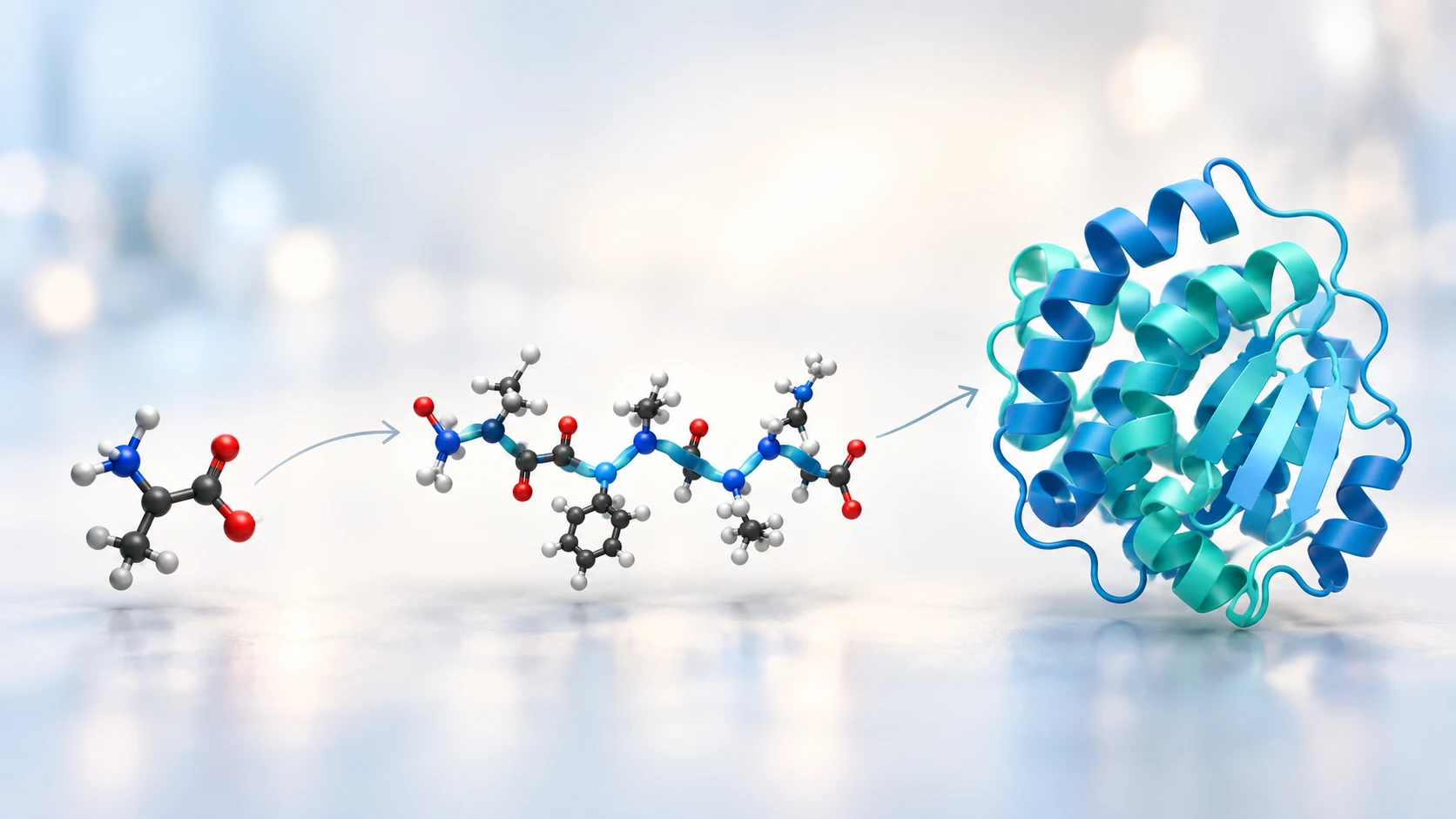
Amino acids, peptides, and proteins are often discussed as if they belong to separate categories. Chemically, they are part of the same family.
Amino acids are the units. Link them together through peptide bonds and they become a chain. Shorter chains are commonly called peptides. Longer chains that form functional molecular systems are commonly called proteins.
That sounds simple until someone asks for the exact number of amino acids where a peptide becomes a protein. Biology does not provide one universal cutoff. Scientific nomenclature, regulatory rules, and everyday usage draw the boundary in different places.
Length matters, but it is only part of the answer. Sequence, shape, folding, chemical modifications, multiple-chain assembly, and biological function can matter just as much.
Here is the clearest way to understand the relationship without turning a useful shorthand into a false rule.
An amino acid is an individual organic molecule with chemical groups that allow it to participate in protein and peptide chemistry. A peptide is made from amino acid residues connected by peptide bonds. A protein is one or more amino acid chains whose sequence and organization support a biological function, often through a defined or dynamic three-dimensional structure.
The terms describe increasing levels of organization, but the transitions are not perfectly sharp.
An amino acid contains an amino group, a carboxyl group, and a side chain attached to a central carbon in the common alpha-amino-acid structure. The side chain changes from one amino acid to another and gives each molecule different chemical properties.
Some side chains are nonpolar. Others carry charge, form hydrogen bonds, react chemically, or help create crosslinks. Those differences become important when amino acids are assembled into a sequence because each residue changes how the chain interacts with water, nearby residues, membranes, receptors, enzymes, and other molecules.
Once an amino acid is incorporated into a chain, scientists usually call it an amino acid residue. The word residue reflects the portion of the amino acid that remains after the chain-forming reaction. IUPAC nomenclature uses this distinction when describing peptide structure.
Amino acids are therefore more than identical beads in different colors. Their chemistry is the alphabet from which peptide and protein sequences are written.
A peptide bond is an amide linkage between amino acid residues. Repeating that connection creates a backbone with an amino end, called the N-terminus, and a carboxyl end, called the C-terminus.
Sequence direction matters. Glycine followed by alanine is not the same molecule as alanine followed by glycine. The ingredients may be the same, but their order changes the chemical environment of each residue and can change the chain's shape, recognition, stability, and activity.
A chain of two residues is a dipeptide. Three residues form a tripeptide. Shorter chains may be called oligopeptides, while longer chains may be called polypeptides. These terms are useful descriptions, but they do not create universal biological borders.
A common explanation says that peptides are short and proteins are long. It is directionally useful, but too crude to stand on its own.
IUPAC guidance notes that peptides with fewer than roughly 10 to 20 residues may be called oligopeptides, longer chains may be called polypeptides, and polypeptides with specific sequences above roughly 50 residues are usually called proteins. The same guidance immediately acknowledges that authors differ greatly on where they begin using the word protein.
That uncertainty exists because structure and function do not change abruptly at one residue count. Some relatively short chains adopt stable structures. Some longer chains remain flexible. Peptides may be linear or cyclic, contain disulfide bonds, include modified residues, or carry chemical groups that strongly affect their behavior.
The label also depends on the field. A biochemist may emphasize folding and function. A medicinal chemist may emphasize synthetic accessibility. A regulator may use a defined threshold for a specific legal or review purpose.
In one United States regulatory context, the FDA defines a protein as an alpha amino acid polymer with a specific sequence that is greater than 40 amino acids. For the quality-assessment policy described in the same document, an amino acid polymer with 40 or fewer residues is treated as a peptide.
That threshold provides consistency for assigning regulatory review responsibilities. It should not be mistaken for a universal scientific law that settles every naming question.
A molecule can be commonly described as a peptide hormone in biological literature while being handled as a protein under a particular regulatory definition. When terminology seems inconsistent, the first question should be: which definition is being used, and for what purpose?
A protein begins with an amino acid sequence, but its function often depends on how that sequence organizes in space.
Scientists describe several levels of protein structure. Primary structure is the residue sequence. Secondary structure includes local patterns such as alpha helices and beta sheets. Tertiary structure describes how one chain folds more broadly. Quaternary structure describes the association of multiple chains when a functional protein contains more than one subunit.
Anfinsen's foundational work established that an amino acid sequence can contain the information needed for a protein to reach its native structure under suitable conditions. Modern protein science adds an important qualification: cells often use molecular chaperones, processing systems, and controlled environments to help proteins fold and remain functional.
Not every protein behaves as a rigid, permanently folded object. Proteins can shift among conformations, contain flexible regions, or include intrinsically disordered segments. The useful distinction is not that every protein has one fixed shape. It is that sequence and structural organization together support the molecule's function.
Amino acid count cannot predict biological power, specificity, or importance.
A small peptide can bind a receptor with high selectivity. A large protein can act as an enzyme, a structural framework, a transporter, an antibody, or a receptor. Another protein of similar size may perform an entirely different task because its sequence and folded surface are different.
Even one residue change can alter local charge, folding stability, receptor recognition, enzyme activity, or susceptibility to degradation. Whether that change matters depends on where it occurs and what role that region plays.
This is why the sequence should never be reduced to a simple ingredient list. Order creates structure. Structure creates interaction possibilities. Biological context determines which of those possibilities become meaningful.
Instead of asking only how many amino acids a molecule contains, ask:
Those questions describe the molecule more accurately than a label by itself.
Amino acids, peptides, and proteins can be produced through more than one route. The molecule's length, sequence, modifications, folding requirements, scale, and intended use influence which route is practical.
Individual amino acids may be made through chemical synthesis, fermentation, enzymatic methods, extraction, or combinations of these approaches. The process must still control identity, purity, stereochemistry, and process-related impurities.
Many peptides are produced by chemical synthesis. Solid-phase peptide synthesis builds a chain through repeated coupling cycles while it remains attached to a solid support, an approach introduced by R. Bruce Merrifield. Modern peptide production also uses liquid-phase methods, recombinant expression, extraction, and hybrid strategies depending on the molecule.
As a chemically synthesized chain grows, incomplete reactions and side reactions can create deletion sequences, truncated chains, modified residues, or closely related impurities. Synthesis must therefore be followed by purification and analytical confirmation.
Many proteins are produced by living expression systems such as bacteria, yeast, or mammalian cells. The host system makes the amino acid chain, but production does not end when the sequence exists. Folding, disulfide formation, processing, post-translational modifications, aggregation control, purification, and biological activity may all require attention.
These are common patterns, not absolute rules. Small proteins can be made chemically, and some peptides are made biologically. The right process follows the molecule rather than the label.
The same principle applies to quality testing. No single test answers every question for an amino acid, peptide, or protein.
For an amino acid, analysts may need to confirm chemical identity, purity, water content, elemental impurities, and stereochemical form. For a peptide, they may examine molecular mass, sequence-related evidence, chromatographic purity, content, related variants, modifications, and biological activity when relevant.
Protein analysis often adds higher-order structure, aggregation, charge variants, glycosylation or other post-translational modifications, subunit assembly, and functional potency. The larger and more structurally dependent the molecule becomes, the less meaningful it is to describe quality with one purity number.
A certificate of analysis should therefore be read in the context of the exact molecule and the methods used. A result that is useful for a short synthetic peptide may not establish the same quality attributes for a folded glycoprotein.
The phrase can help a beginner see the family relationship, but it hides meaningful differences in folding, manufacturing, analysis, stability, and terminology. Some peptides have substantial structure, and some proteins are relatively small.
A residue threshold may be valid within a specific regulatory policy. Scientific usage remains less rigid. Always identify the context before treating a cutoff as universal.
Length is not a potency scale. Biological activity depends on sequence, conformation, target interaction, exposure, stability, and the system being measured.
Composition does not establish sequence. Rearranging the same residues creates a different chain, and different chains can adopt different structures and interact with different targets.
Peptides can be synthesized chemically or produced biologically. Proteins can also come from several production routes. Source affects process controls and impurity risks, but it does not replace a structural description of the molecule.
Accurate terminology improves more than vocabulary. It shapes what questions should be asked.
If the molecule is a short synthetic peptide, sequence-related impurities and chemical modifications may dominate the analytical strategy. If it is a larger recombinant protein, folding, aggregation, host-cell impurities, and post-translational modifications may become central. If it is a free amino acid, stereochemistry and small-molecule purity may be more relevant.
The name should guide the investigation, not end it. A careful reader still needs the exact sequence, structure, production method, analytical methods, biological role, and evidence for any claimed outcome.
Amino acids are the chemical units. Peptides are chains built from those units. Proteins are amino acid chains whose organization supports a biological function, often through complex three-dimensional structure.
Chain length helps describe the progression, but it cannot carry the entire definition. Scientific authors use flexible conventions, while regulators may adopt firm thresholds for specific purposes.
When the label is unclear, look past the word. Ask about the sequence, the structure, the modifications, the manufacturing process, and the function. That is where the real distinction lives.
3. Anfinsen CB. Principles that govern the folding of protein chains. Science. 1973;181(4096):223-230.
This article is for general educational and informational purposes only. It does not constitute medical, scientific, laboratory, regulatory, diagnostic, or treatment advice.
Terminology can vary by scientific field, publication, jurisdiction, and regulatory purpose. Classification as an amino acid, peptide, polypeptide, protein, or biological product should be evaluated using the definitions that apply to the specific context.
Do not use this article to select, obtain, prepare, dose, combine, administer, or discontinue any product or treatment. Consult qualified medical, scientific, legal, and regulatory professionals when decisions depend on molecular classification or intended use.